

Staff’s Name: Nur Qistina Ainaa Mohd Fadli
Book Title: The New Harvest: Agricultural Innovation in Africa
Author: Calestous Juma
Publisher: Oxford University Press
Year of Publication: 2011
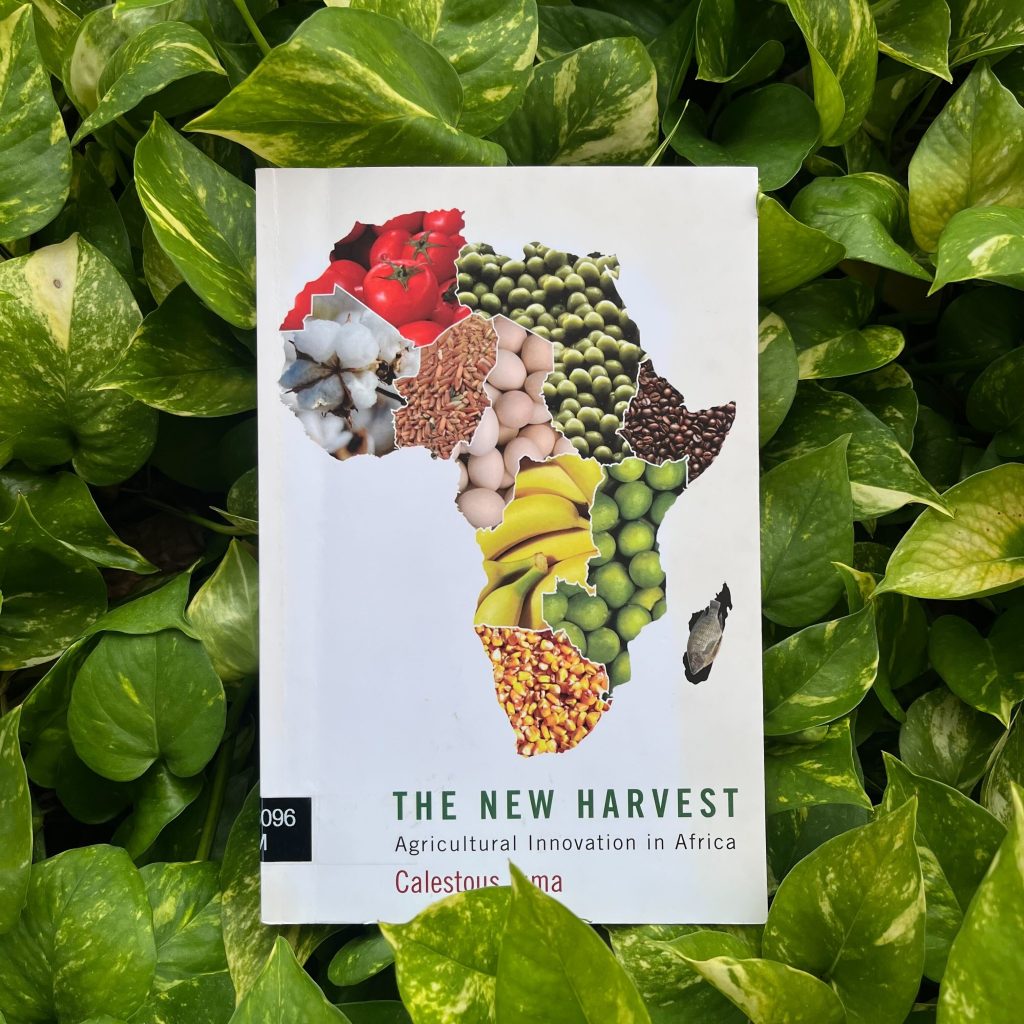
Official Synopsis:
African Agriculture is currently at a crossroads, at which persistent food shortages are compounded by threats from climate change. But, as this book argues, Africa faces three major opportunities that can transform its agriculture into a force economic growth: advances in science and technology; the creation of regional markets; and the emergence of a new crop of entrepreneurial leaders dedicated to the continent’s economic improvement.
Filled with case studies from within Africa and success stories from developing nations around the world, The New Harvest outlines the policies and institutional changes necessary to promote agricultural innovation across the African continent. Incorporating research from academia, government, civil society, and private industry, the book suggests multiple ways that individual African countries can work together at the regional level to develop local knowledge and resources, harness technological innovation, encourage entrepreneurship, increase agricultural output, create markets, and improve infrastructure.
Comments:
I found The New Harvest both inspiring and eye-opening. Juma’s writing blends research and optimism, showing how agriculture can be more than just a sector, it can drive innovation, industrialisation, and inclusive growth.
What stood out most was his focus on combining technology with local knowledge. Rather than relying on external forces, Juma empowers African nations to lead their own transformation through education, science, and policy reform.
His ideas remain highly relevant today, as food security and sustainability continue to shape global priorities. The New Harvest reminds us that agricultural innovation isn’t only about feeding people; it’s about building systems that sustain livelihoods and create lasting opportunities for future generations.
Excerpts:
Innovation system
“Innovation system can be defined as a network of organisations, enterprises, and individuals focused on bringing new products, new processes, and new forms of organisation into economic use, together with the institutions and policies that affect their behaviour and performance.” – Page 51
Agricultural Innovation System
“Theory, evidence, and practice confirm that clusters are important source of innovation. Africa is placing considerable emphasis on the life sciences. There is growing evidence that innovation in the life sciences has a propensity to cluster around key institutions such as universities, hospitals, and venture capital firms.” – Page 62
Enabling Infrastructure
“Water is also a critical input beyond agriculture, and successful irrigation policies and programs must take into account the key role of water in energy production, public health, and transportation. For small farmers, low-cost technology is available, and there are cost-efficient technical solutions om even some of Africa’s most difficult and arid regions.” – Page 90
Gender Parity in Agricultural Development
“Indeed, if there were any consistency between current educational systems and adequate human resource development, there would be at least gender parity in all fields related to agriculture and trade.” – Page 118
Regional Cooperation and Trade
“Having countries come together to address problems of regional trade and particularly including representatives from both the private and public sectors, allows nations to identify and address the barriers to trade.” – Page 168
Building Capacity in Public Service
“Successful implementation of science, technology, and innovation policy requires civil servants with the capacity for policy analysis-capacity that most current civil servants lack. Providing civil servants with training in technology management, science policy, and foresight techniques can help integrate science, technology, and innovation advice into decision making.” – Page 178
Governing Innovation
“The need to enhance the use of science, technology, and engineering in development comes with new risks. Africa has not had a favorable history with new technologies. Much of its history has been associated with the use of technology as tools of domination or extraction.” – Page 196
This book is available at the Perdana Library. If you are interested in reading or borrowing the book, please visit our Library in Putrajaya, or contact us at 03-8885 8961 (Library Counter).
